
A Brighter Future for community care
Better things are possible
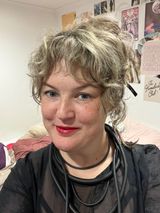

Many of you will have seen Quentin McDonald’s name pop up in the comments. What he shares is always considered and thoughtful. So I was so happy when he decided to contribute to our Brighter Future project.
I feel like we need the Brighter Future Project now more than ever. It’s so easy to feel hopeless, and that’s exactly what this government wants. There’s absolutely no way we will have a change of government if everyone isn’t inspired into action.
I hope Quentin’s vision inspires. It’s just one of so many. Asking - what could be? Instead of ‘what is’ - that’s so important for all of us. We need to imagine a better future and fight for it.
I love Quentin’s vision of moving forward, of community, and of coming together to help each other. It’s beautiful to acknowledge that we don’t always know how bad things are getting, but the best time to change and work on fixing things is now.
Arohanui Emily
Better community care is possible
A Brighter Future by Quentin McDonald, September 2026
BC Better Futures - Issue 12, September 2046
BC Better Futures is British Columbia’s leading online journalism collective covering sustainability, climate response and bold ideas to improve lifestyles for all. Our reporter Karen Rosseau has been touring Aotearoa/NZ, and in this issue she’s reporting from the small sea-front community of Diamond Harbour, near the southern city of Christchurch.
As community health worker Rose Mitchel leads me down through the gate to the house of Diamond Harbour resident Quentin McDonald, we encounter the owner rather guiltily dragging an aluminium ladder up to the road-side garage. A garden hose sits neatly coiled nearby.
"You haven’t been up on that thing, have you?" Rose asks.
Quentin is flustered and explains that he just wanted to give the solar panels a rinse after recent high winds had left dust and salt on them.
Rose says - patiently, it’s clear that this is a conversation she’s had many times, with many people - that it’s better if he waits for her son Jed to do it. Jed, a high-school student, is one of a number of young people who will receive a community-funded education scholarship in return for regular acts of service in the area.
Quentin, who is in his early 80s, seems apologetic, but Rose gives me a look to suggest she doesn't believe it’s the end of it.
After introductions and the usual awkward moments until it’s established I’m not an American, Quentin welcomes us to the small house he shares with his wife of over 50 years. She is out when we visit; volunteering at the local school. The house is one of many perched on the volcanic rock of Lyttleton Harbour.
The check-up begins with Rose taking Quentin’s blood pressure (slightly high.) A hearing and eye check, then a quick look at some moles on his face and arms previously identified as a risk (Aotearoa has high rates of skin cancer). They discuss medications and resolve a mystery about why there seem to be some pills left over from the month's allowance. Finally she asks him about the pain in his knee, a long-standing issue of arthritis. "Lots of people tend to down-play their symptoms," Rose suggests, but Quentin assures her he’s being forthright.
Later, when we are alone, she tells me she tends to watch for movement quality when her clients are doing normal tasks, like fetching her a cup of tea. "That’s something a regular doctor finds hard to do”.
After the consultation we move outside, high above the water which sparkles in the autumn sunshine like the gemstones that give the area its name. The sun is fierce, but a cool sea breeze makes it more bearable. "We used to moan about the Easterly wind but we’ve been very grateful for it given how dangerously hot other parts of the country are getting," Quentin says. On the other side of the harbour is the working port town of Lyttleton. One of the new generation low-carbon cargo ships is sitting waiting to be unloaded, wing-like sails gleaming white.

Quentin returns inside to prepare some refreshments and I chat to Rose about her job.
A Diamond Harbour resident for 15 of her 47 years, Rose had always hoped for a career in nursing but the demands of raising a family and the cost of training had made it impossible. When she heard about the role of community health worker she immediately applied, before even telling her family. "It was just what I always wanted. The training was free and was flexible enough to accommodate her family obligations as are the work hours, and I wanted to do something for my community,” Rose says.
She spends her days visiting nearly every household in this section of the settlement. The all-inclusive scheme is based on one used for many years in Costa Rica and other Majority World nations. Visits are scheduled on the basis of need - elderly patients might be visited once a month or more, new parents might be seen weekly, families with school-aged children twice a year. There is a medical practice in the community, but due to the nationwide shortage of doctors there’s only one in attendance for two half days a week.
Quentin returns with tea, (homegrown, slightly acrid but with a pleasant lemon after-taste) and as we sip I ask about how the community health worker scheme came about. "It’s a nation-wide initiative but the objectives are all set within our community," Rose explains. "I feel like I have a hundred bosses, but it’s all good!” The "community” in this case is a relatively small area - there are four associations that cover the 2000 people in the wider Diamond Harbour area. "This is a lot more local than the old community board that existed when we moved in,” Quentin says. “That covered the entire peninsula, which was over 8000 people”.
I’m curious what other changes Quentin has seen in the 25 years he’s lived in the area. "Heaps!” He tells me how a simple food-sharing mutual-aid table evolved into a regular food trading market. "People kept an eye on what other people were growing and tended to look for complimentary things. We have a lot of citrus," I’d admired the trees on the way down the house. In the half-dozen raised garden beds that have replaced what was once a front lawn, Quentin has been concentrating on radicchio and the Japanese radish Daikon in the winter. "They’re not to everybody’s taste but there’s enough people who want them and they seem to be OK with our warmer winters”.
To what extent is the community self-sufficient, I ask. "It makes a difference in access to fresh food but most people can’t grow anywhere near enough for themselves even if they have the land, know-how or time - and most don’t," Mitchell explains. Every little helps, and gardening is good for health and wellbeing, but it’s only part of the sustainability puzzle. In addition to the trading market there are several large community gardens with the produce distributed to those who contribute, those in need, or those who are unable or don’t have space to grow their own. Still, as Quentin acknowledges, it’s still more a matter of social cohesion and turning one of the country’s most popular hobbies into something of a social good rather than true food resilience.
Energy is also a community project. Nearly every house has solar panels and many with batteries. Quentin’s household is now running its second set of panels and third battery, each cheaper and with more capacity than the last. The new sodium-ion model is expected to outlast him by a couple of decades, Quentin says proudly (if a little darkly.) Based on a collective model first championed in the township of Lyttleton across the water, the benefits of solar are shared by all who have joined the collective. And, following the receipt of a grant from the Government two years ago, a large solar agriculture project is under construction, growing crops and sheltering stock under rows of panels on the sloped hillside behind the town. "When that’s complete and the batteries are on line," Quentin says, referring to industrial-scale batteries being installed in a local substation, "we’ll be essentially a micro-grid and the power should stay on even when storms take down the power between us and the main grid”. He says they’ve been losing grid connection at least three times a year for the last decade.
I’m in the process of asking about other climate adaptations when I’m startled by the whirr of wings just above our heads. A Kerurū - an enormous native woodpigeon - swoops over to land precariously on the palm-like cabbage trees below. It sits there, swaying and dipping its head before beginning to feed on the seed-rich flower stalks. I comment on the richness of the bird-life. Quentin says it’s greatly increased over the last two decades. He points to a Tūī, a darkly iridescent bird with a white tuft around its neck that gives it a clerical appearance, and a call that ends in a burst of static. "There was a time when seeing one those would have been big news - now they are everywhere”.
The birds are nice to see, Quentin explains, but they are only a signifier of a much more consequential ecological recovery. When he first arrived in the area, he could walk along the cliff-top track and barely see a native plant. Thanks to restoration efforts and trapping of mammalian predators, mostly by volunteers with local Government support, there’s a much richer environment of native flora, and the fauna - especially birds - has returned. "But the other important thing about the native planting is that it offers climate resilience,” Quentin says. “Most of our area is well above sea level but we are still susceptible to rain and wind events. The native plants are much more hardy, they slow down the water rushing off the hills and we have fewer road closures from falling exotics like pine or gum trees”.
The community has had to adapt to frequent isolation, as the road around the harbour has several points only barely above sea level. They’re now inundated several times a year; an event that local government had signaled as a possibility 25 years earlier. "It wasn’t until it happened for several weeks in one year that people really understood what it meant,” Quentin says, reflectively. This was the spur for a lot of people beginning to think about community resilience. As we’re chatting, Quentin points out the electric ferry, one of two, that carry people and - in an experimental program - also bears freight containers the short distance across the harbour. "That’s been a lifeline, especially for medical stuff," Rose adds.
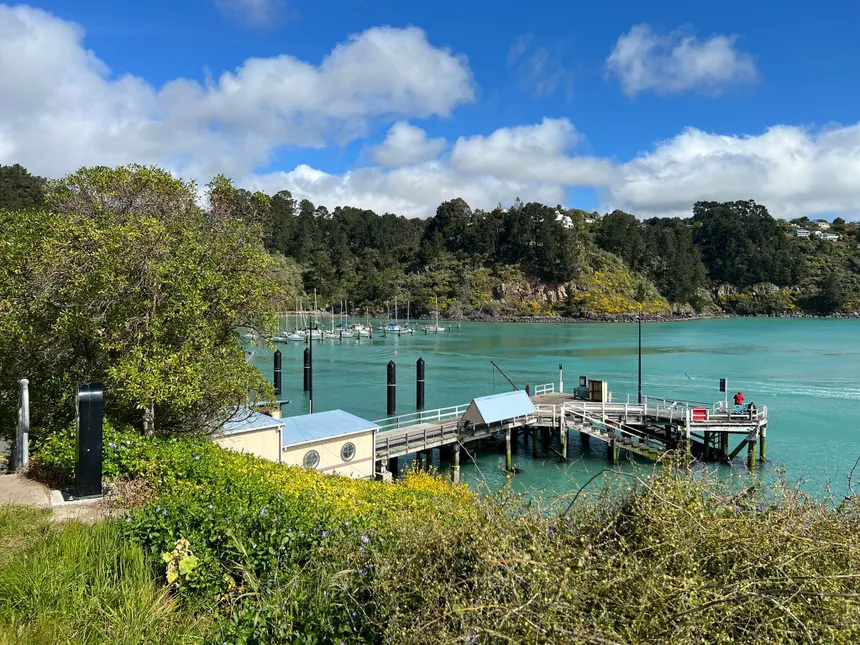
It was a revelation, Quentin says, to understand the way that so many actions are connected. The planting wasn’t just good for the birds or climate adaptation; it greatly reduced the erosion of the fine clay soil that covers the ancient volcanic rock in most of the area. That in turn improved the health of the harbour. Local Māori hapū Ngāti Wheke has a long term project to reseed the kelp beds in the harbour, as well as restocking crayfish stocks to bring down the kina (sea urchin) population that devastated seabeds in the 2030s as warm water moved south. Together, these actions have led to a flourishing of fish life not seen since the early 20th century. Twice a week, young members of Ngāti Wheke bring kaimoana (seafood) for sale in local markets. "It’s a classic example of what’s good for Māori being good for everybody," McDonald says. "I don’t think I’ve ever eaten so much fish as I have in the last few years”.
If all these decisions are being made locally, is there always consensus? Both of my hosts laugh. "There’s always been a... wide range of opinions, but we get there in the end," says Quentin, who served on the community board five years ago. "We always had lots of strong groups within the community - the rugby club, the volunteer fire service, the school - it was just a matter of connecting them all up. But people hate meetings and I don’t blame them. We found it better to have a community BBQ and then do a bit of business when people have food and drink inside them. There were some funny ideas to start with, people read all sorts of nonsense online - like that they’d be imprisoned in their community or we’d all have to live in one big barn - but people eventually believe the evidence of their own eyes and what they hear in person from their neighbours”. Rose adds, with an obvious sense of satisfaction, that local childhood vaccination rates are among the highest in the country.
One recent innovation Quentin is especially excited about is an experimental program in participatory budgeting where communities will be able to set their own spending priorities. "At first I thought it would be potholes, potholes, potholes. And yes, that came up. But when people actually sat down in groups and talked it out there was a much better understanding of the tradeoff between, say, keeping the library and making every road dead flat. This never happened when it was just being decided in Christchurch”. Curiosity and imagination are the most important things, he says. "Once we explored it a bit more we realised that one of the most vocal roading advocates has a back issue - potholes are literally torture for him to drive over - but he still needs to drive. So we were able to identify the key routes that needed addressing with that sort of thing in mind.”
It’s time for Rose to continue her rounds, and as we walk up the drive-way, I ask Quentin what his hopes for the future are. "Personally, I hope we and all our friends of the same age can stay here as long as possible, perhaps to the end. It seemed unlikely when we moved in, but with community support" - he shares a smile with Rose - "I’m thinking we might make it”.
I ask: are there any lessons from the last twenty years he’d like to share? Anything he wishes he, or the people around him, had known twenty years ago?
"Pay attention,” he says. For much of his adult life, he felt that he was oblivious while things got slowly worse. "The environment degraded, people didn’t trust each other, kids went to school hungry. But all of that can be fixed - by electing better governments at the national scale, and by just talking to neighbours and people in the community at the neighbourhood scale. I’ve realised now that we can, and should, ask for better. It doesn’t matter how small the steps are, we just have to keep moving forward.”
Thanks so much for reading, and to Quentin for his amazing, thoughtful guest piece. I am able to commission and pay for guest posts thanks to the support of paid subscribers and donations, so if you can, please contribute.
As always, I'd love to know what you think of these Brighter Futures. Please let me know in the comments - and if you' d like to submit your own, let me know at emilywritesnz@gmail.com.