
A Brighter Future for Huntly

At the beginning of the month, we launched a big campaign here at Emily Writes Weekly. The Brighter Future project is incredibly dear to me. It's kaupapa is simple. We are asking an important question of everyone in Aotearoa: What would this country look like in a decade or so if we actually did what so desperately needs doing?
When we launched the campaign with Josh Drummond's beautiful essay The Brighter Future we immediately had folks sign up to share their visions.
I am so excited to share a vision here by R. M. Caldwell, author of The Fast & the Fastidious. This vision sees us in the future in Huntly, Aotearoa's first solar 'city'. It's inspirational and powerful and hopeful. Everything the Brighter Future project is about.
Like all of the pieces we share under The Brighter Future banner, we hope this post encourages discussion about what the world could look like if we acted, cared, and tried.
Because it’s an election year, we have decided now more than ever we need this project. People feel like nothing they do matters. This project is about saying: It all matters. Thank you for supporting this project.
Arohanui, Emily (and Josh)
Feel free to skip to the comments if you read this already in your email!
Huntly: Solar City
By R. M. Caldwell
It’s a lovely day and the sun is shining.
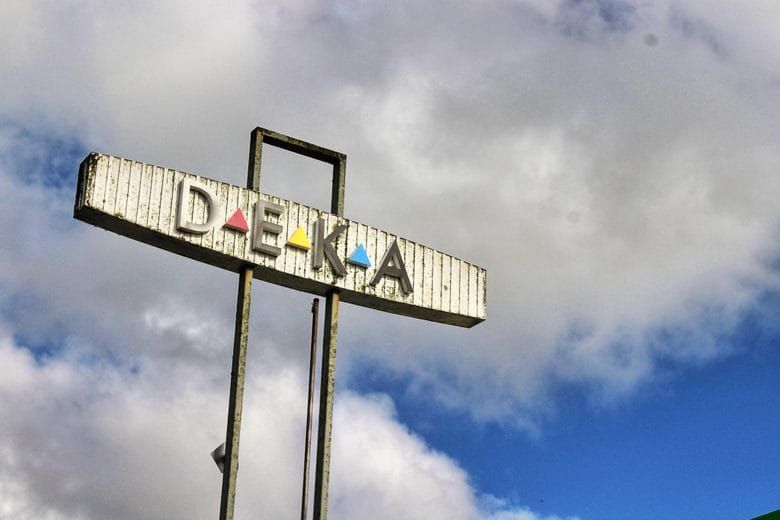
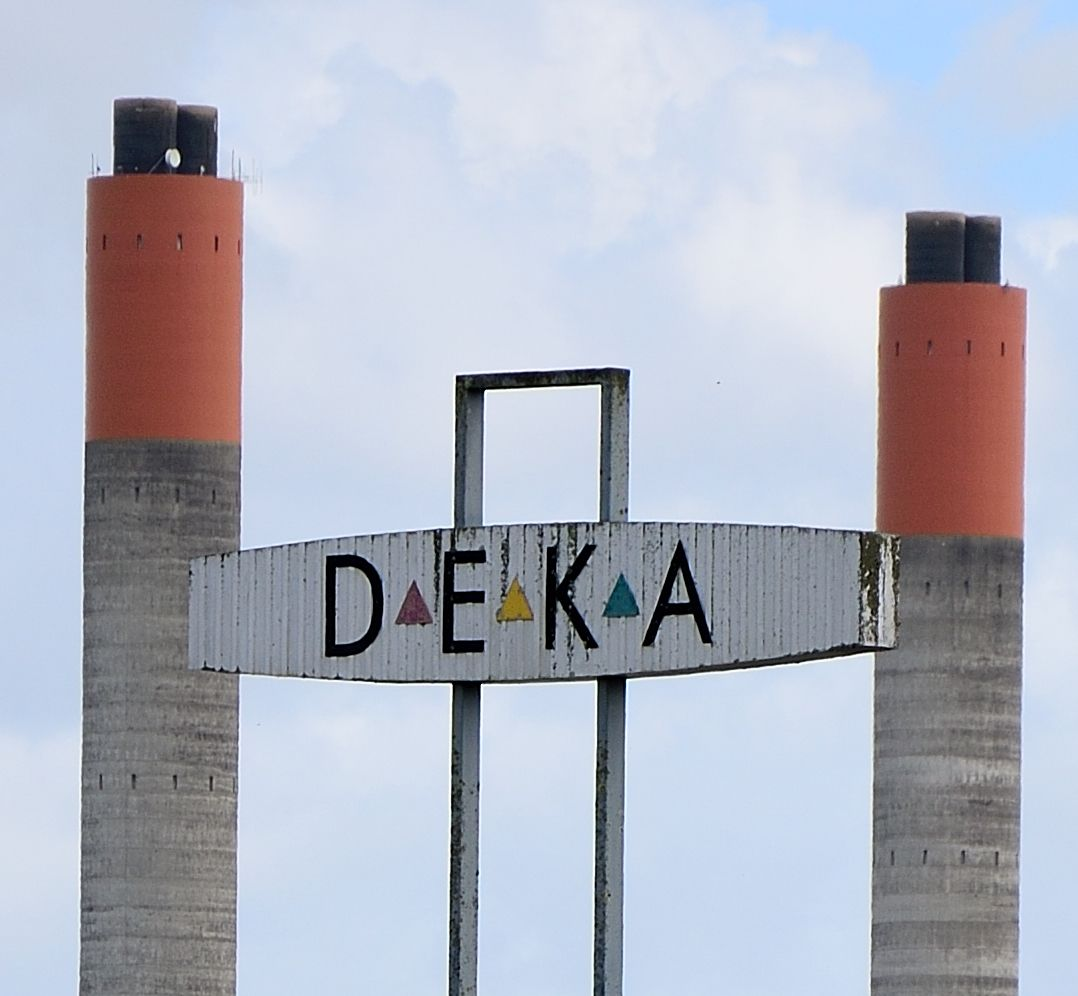
The sign is still there. The cyan, magenta and yellow triangles have faded but it got a clean-up a few years back and the letters are as bold as ever.
D E K A.
The world-famous-in-NZ-and-nowhere else chain store closed in 2001. 35 years ago, now. But the sign is still there in Huntly to baffle future archaeologists and current Gen Z parents trying to explain to their kids that it was before their time.
But we’re not looking at the Deka sign today. We’re looking at another installation, one that casts an even longer shadow. There’s no clear answer on which New Zealand house got the first solar system. It was probably in the 1970s, during the first big oil crisis — solar has been around a long time. When the Sunshine Project kicked off, there were already quite a few Huntly houses that had solar already, but the project really kicked it into gear. More than one school kid has claimed that their house was the first to get Sunshine, but in reality, it was probably several at once.
After the first there was the next, then the next, as tends to be the case. Eventually, it was all of them.
Solar panels on every home in Huntly. 2600 dwellings, give or take a dwelling or two and some quibbling about the definition of “dwelling.” All for 26 million dollars.
Honestly, it came in at a little under that: economies of scale balanced out some of the unexpected project elements. Not every house took up the offer — a small group of hold-outs refused, as was their right. The hold-outs dwindled each year, though: there’s just something about “$0 power bills,” that changes hearts and minds.
It was an experiment. One with many detractors. Campaign finance reform and social media safety rails had put a dampener on the power of the big think-tanks but they could still know how to stir up astro-turfed campaigns. Government overreach, waste of money, “energy communism.”
“Imagine if the government could just switch off your power!” they cried, as if that wasn’t already the case and decentralized power generation didn’t actually make it harder for an authority to turn the power off. So sure, some people opted out, but most took up the offer. Power bills had been rising sharply since the last oil shock and The Big Bubble finally going pop. Anything that would take the edge off was welcome. It seems so normal now but it was so wild at the time. And yet, not at all. Every civilisation in history has run on solar power. When you really get down to it, all power is solar power. It’s just the delivery systems and efficiency that changed. Before the Industrial Revolution, it was all based on agriculture: How much sun could your fields catch to grow crops and feed stock? Then we found a new source in fossil fuels, but those are still solar. Millions of years of solar energy absorbed into plant and animal matter then compacted by the pressures of the earth. An incredibly energy-dense source, in enormous quantities.
We burned through nearly all of it in 150 years, and we all know the consequences. We’ll be living with them for centuries. Millennia. The age of fossil fuels will show up like a neon sign in the geological record; looking at the abrupt carbon explosion, alien geographers (or our distant descendants, if we’re lucky) will say “What the hell happened then?”
Turning back to the sun isn’t wild. It’s what humans have always done. The panels on the rooftops of Huntly powered the homes during the day, feeding into the grid what they didn’t use. Because it was local it saved a lot of distribution loss too. It’s pretty inefficient to transport electricity from Central Otago to North Waikato.
“But what about night-time?!” came the screams from talk radio. It was the same crowd that denied climate change if it was a cold day.
(It’s not fair to ask if they were lying or foolish. They could be both.)
At night, of course, we use the hydro power we save during the day. The reply became so ubiquitous that it became a joke. ‘Butwhataboutthenight.co.nz’ even got a plug on Seven Sharp.
Power bills plummeted. During the day, power bills went negative. If the gentailers had still been around, their shareholders might have sued. Okay, let’s be honest: would. But the government had re-nationalized the lines and the gentailers in their previous term. Line maintenance was still needed. In fact, the new complex system in Huntly needed more of it than ever.
But the bills were still cheaper.
All but two of the holdouts got in on the funding before the window closed.
Why Huntly? Why the joke town, famous for a DEKA sign and a power station that only sometimes turned on?
It was small enough to roll out the pilot, large enough for it to show a scalable model. Relatively sheltered from the annual 100-year storms that buffeted the coasts. Fairly seismically stable, inland from tsunamis, a decent distance from the nearest active volcano.
And it had something else too. Something that came into play in Stage Two.
It had a battery.
Home batteries were pretty good already, of course, and most homes — even the ones without panels; not all houses can take them — had one as part of the Sunshine Project. That’s what makes a distributed grid work.
But economies of scale come into play in power storage too. Bigger enterprises need baseline power: big amps, on demand. And this was before Lake Onslow finally got the green light. Coal was, of course, on its way out, despite the violent thrashing of the industry and the politicians in their pockets. Coal just didn’t make economic sense and, once it was free enough, the free market destroyed it. Sometimes the economists are right. Not often, but sometimes. It’s a bit of a stopped clock situation.
Anyway, the Huntly Big Battery. Molten salt thermal batteries aren’t quite as efficient as pumped and stored hydro, but they’re still pretty good. Retrofitting the Hunty power station to run on molten salt to store excess energy and distribute it as needed was a bold move. But it was so quintessentially Kiwi that even the talkback hosts were more joking than mean about it. (An ad featuring a worker fixing the turbine belt with a pair of Bendon stockings won advert of the year from the relaunched Fair Go Ad Awards.) Another second turbine was retrofitted too. They’re not built to last, and the station was already old, but it’ll do until the other eligible dams convert to pumped hydro.
Now there’s plenty of power at night. For Huntly, and for much of the rest of the North Island as well. Kaiatia, Thames, Levin and Queenstown were next in line for the solar rollout. Lessons had been learned from Huntly. More lessons were learned in the second wave. Queenstown taught us how to deal with snow. Thames taught us how to deal with storms. Cyclone Cassandra hit the Coromandel hard. 1 in 5 systems were damaged, 1 in 20 were a write-off. But before the naysayers could get their narrative going, videos started coming out of Thames. Major power lines to the area were damaged. But 80 percent of the systems were still going. Local lines companies were able to get them linked up. Some parts of the Coromandel didn’t get power back for 10 days. But solar-powered Thames was up and running in 24 hours, a hub for recovery efforts in the area. And a lot of the houses never saw so much as a dip, let alone a power cut.
There are roughly two million dwellings in NZ. It was about $20 billion to put solar on all of them. Less than half the budget the old Coalition government proposed for their 17 roads of national significance back in 2025. Two million is a lot of houses. It’s slow going. All the flooding in Auckland means progress is slow there, but the big industrial parks were quick to put solar on their vast roofs — another one of those business decisions that just makes common sense — and the new water infrastructure should help. But there are also a lot of jobs in installing, maintaining, and tracking. Business is booming for the electrical engineer business. And we’re saving more from lower lines and power bills than we’re paying in raised taxes.
The Deka sign is still there, overlooking the shining panels on the roof nearby.
But there’s another sign at the end of town, one that the locals are proud of.
Huntly: New Zealand’s First Solar City.
It’s not technically a city, but “town” doesn’t alliterate very well, so let’s let them have this one.
After all, it’s a lovely day, and the sun is shining.
R. M. Caldwell is an author of fact and fiction based in Kirikiriroa, New Zealand. His first novel, The Fast & the Fastidious, is launching Tuesday, March 31. Published by Hatchette Aotearoa in New Zealand and by Harper Perennial in the US, The Fast & the Fastidious is described by Publishers's Weekly as "Delightful... Caldwell captivates from the first page, spinning an escapist tale that will thrill fans of Bridgerton and other, similarly irreverent takes on Austenesque romance." It arrives at Whitcoulls and other good Kiwi book stores on March 31, and is available for purchase on Amazon from April 14.
You can RSVP to the launch event on Tuesday 31 March, held at the Meteor Theatre in Hamilton, via Facebook or on the Meteor's website:


Kia ora! Emily here again, I'd love to hear what you thought about this piece - please leave your comments below. The Brighter Future project runs on your support. Thank you for supporting it by sharing, commenting, and giving koha to keep it going.
If you can give a koha to the kaupapa, I'd be so grateful.
Every little bit helps so much.
Thank you!
If you'd like to be part of the Brighter Future project email Josh at josh@tworuru.com or fill in this very quick form: https://forms.gle/rJfbv8gS1XVZ5C5bA
Arohanui Emily x