
Government's treatment of women in Aotearoa goes to the United Nations

One year after legislation killed existing pay equity claims and basically ended the opportunity to bring new claims, the government is being taken to the United Nations.
It's a huge deal.
The team bringing the complaint to the UN includes Te Kāhui Tika Tangata Human Rights Commission and New Zealand Council of Trade Unions.
Here's an explainer so you know what exactly is going on.
Feel free to skip to the comments if you read this already in your email!
What even is pay equity?
Pay equity is the same pay for different work. If the a given job - let's say nursing - has the same or similar level of skill, responsibility, and effort as another job - let's say engineering - pay equity is a way to keep things fair. Historically, this hasn't been the case. In some jobs, such as teaching, nursing, or caregiving, wages have often been kept lower than in jobs where the work is performed mostly by men, simply because those roles are mostly performed by women.
Pay equity is about making sure that everyone's work is valued based on their skills, responsibilities and experience - not their gender.
The Government is both the lawmaker and the largest employer
affected by pay equity, because the Government employs a lot of nurses, teachers, caregivers, and people in similar jobs.
Pay equity is a matter close to my heart. Not just because I come from a family of working class people, and my husband is a teacher aide. My best friend has interviewed hundreds of workers as an advocate. She explains why it matters, really well:
I’ve spoken with youth social workers - four years plus of training and more than a decade of experience - who are paid less than their 18-year-old sons working in unqualified construction jobs. I’ve interviewed nurses who rely on food banks to get by, and teachers who tell me their staff room conversations are all about which Australian schools are hiring. I spoke with a librarian who can’t afford flights to the South Island to visit her dying father.
It is appalling that we treat women workers, essential workers, so badly.
What did the government do exactly?
One year ago today, National, NZ First, and ACT killed pay equity for more than 180,000 workers (mostly women) in care and disability support, education, health, and community and social services.
They did this without consultation or notice, and deprived all women and workers of the opportunity to appeal their decision. Thanks largely to ACT MP Brooke van Velden, decades of bipartisan work were undone in one 45-minute ministerial meeting.
This causes huge disadvantage to wāhine Māori, Pacific women, migrant women, disabled women, and older women workers, who face the largest pay gaps with men. The pay gap for Pacific women is 15.8 percent. This is three times the
overall pay gap of 5.2 percent based on median hourly earnings. Disabled women
face a pay gap of 14.8 percent, Māori women are at 12 percent, and Asian women
10 percent, all significantly higher than the national average.
What does it look like really? Here are some quotes from workers in Aotearoa about how pay equity impacts them:
"A pay equity settlement for me would mean I could pay rent and have a budget for food." - Teachers Aide
"We have so many qualifications to do this jobs, it’s eight jobs in one and we are getting paid almost the same as minimum wage." - Health Care assistant
"At a personal level it would mean I could get my roof fixed, it’s raining in my kitchen currently." - Teacher Aide
"They expect people to work 24/7 literally keeping people alive and they want to pay us pennies for it." - Aged care nurse
"It would mean I could jump on a plane and go see my dad who’s really suffering at the moment." - Librarian
"When the pay equity claims got cancelled I was very very upset, I had tears in my eyes. I was involved in compiling the data around what carers do. Across the country, both in hospital and out in the community, what carers do is incredible and they should be recognised for that. They add so much to the lives of vulnerable New Zealanders." - Aged Care worker
"It would mean I could afford medical expenses, have security in my life and not have to come home at the end of the day and look on seek to find a second job."- Teacher Aide
"It feels like the government is giving us a big slap in the face and saying “you’re not worthy." - Nurse
I'm doing my best to bring you explainers on the stuff that really matters ahead of the election.
If you can give a koha to the kaupapa, every little bit helps so much.
Thank you!
What has happened since?
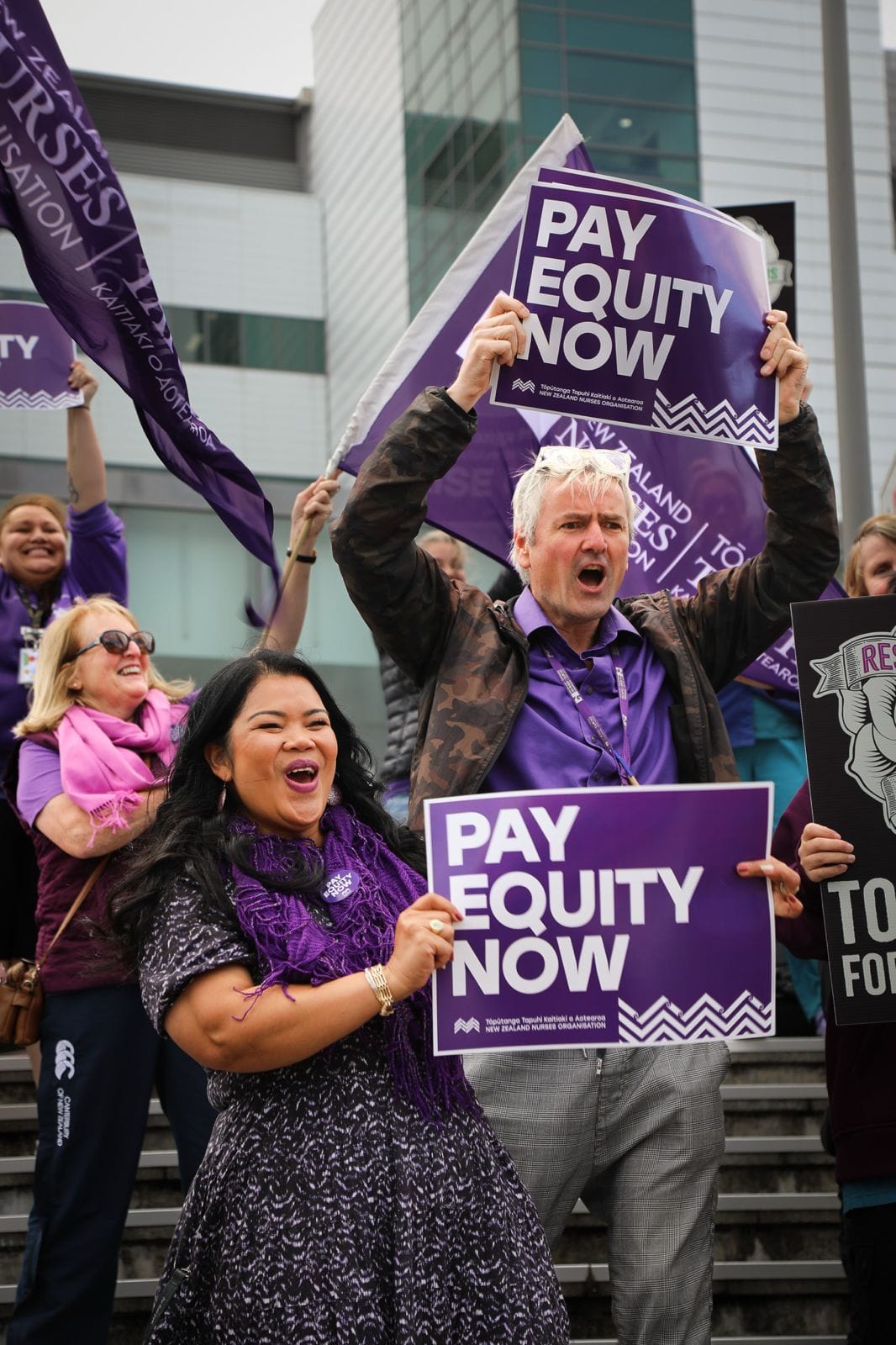
Everyone, from unions to community groups to charities to individuals to churches and religious organisations, has been fighting back. A petition to Parliament with over 96,000 signatures was presented. The government has been taken to the High Court, thousands of New Zealanders have protested across the country, and thousands more have committed to voting for Pay Equity at the election on November 7.
Who took this to the UN?
The Pay equity Coalition Aotearoa is made up of the National Council of Women, Te Kāhui Tika Tangata New Zealand Human Rights Commission, Working women’s resource centre, Business and Professional Women NZ (BPW), Rural Women, PACIFICA Inc, YWCA, Aotearoa Women’s Watch, Peace Movement Aotearoa, Action Station, Presbyterian Social Services, New Zealand Council of Christian Social Services (NZCCSS), UNICEF Aotearoa, and The New Zealand Council of Trade Unions Te Kauae Kaimahi (representing more than 320,000 union members across 27 affiliated unions) and individual advocates for gender justice.
The coalition has been involved in legislation around pay equality and equity since New Zealand’s groundbreaking pay equity law: Equal Pay Amendment Act 2020 which amended the 1972 Equal Pay Act. They're the ones who went to the United Nations.
What does it mean to take a UN complaint?
It's a huge deal. Dame Judy McGregor says it best, really. "This is no longer just a domestic policy debate. It raises serious questions about whether the law now enables state-sponsored discrimination against women, and what that means for New Zealand’s commitment to fairness and human rights."
National, NZ First, and ACT have embarrassed our country. We were once known as the first country to "give" women the vote in 1893. Now we're the country enshrining discrimination and inequality for women into our laws.
As other countries face cost-of-living crises and fuel shortages, they're looking to support workers, especially those most at risk of discrimination. Our government is doubling down on attacks against those very workers.
Why is there a UN complaint?
The law itself now creates a system that structurally disadvantages women. This is an an attack on women - which is illegal under international law.
Equality in employment for women and equal pay for work of equal value are protected under the United Nations Convention on the Elimination of All Forms of Discrimination Against Women (CEDAW), to which New Zealand is a signatory.
The complaint is made under this protocol.
This government can't just choose to ignore this.
A clip from Three News explaining the fight for pay equity
Why should I care?
The people whose rights to pay equity were taken away are the people who educate your children, who care for your parents, and who look after you when you're sick. They're the "essential workers," as you might remember them being (truthfully!) called during the Covid pandemic. They're the backbone of this country.
There are people like Clare Preston, a secondary school teacher, who said:
It feels like a betrayal. It feels like women’s rights, whether we get them or not is just on a whim and not enshrined. It makes the state of women's labour rights feel really precarious.
As well as those material cost of living issues I just think about men that I’ve known in my life, and how quickly they’ve advanced through pay scales – how they’re earning a lot more money much earlier. And that’s why men retire with a much larger amount in retirement savings.
And Tamara Baddeley, a Home & Community Support worker, who said:
The axing of my pay equity claim just makes me feel completely under-valued in society. Even though I feel my job is rewarding and satisfying to me there’s a view in some areas of society that caring is basic female work, that it is what intuitive to being a woman and what we should be inherently doing because it is women’s work.
That we shouldn’t be paid properly for the job we do because we are women.
Not many things in life are binary, but this one is. Either you are for discrimination based on gender, or you're against it. It's not that hard to understand.
What can I do?
Vote these misogynists out in November. It's that simple. Tell everyone you know to vote and make sure they're enrolled to vote. Vote for the parties that will commit to pay equity.
Please share this info with everyone you know. It's important people understand just how huge this all is.