
Parents fined $30 a day for having unwell, dying, or disabled kids

Katie's son, 13, was running through school when he slipped over and hit his head. Hard. He was knocked unconscious and suffered a serious concussion and brain injury.
For the last ten weeks, his parents have been run ragged as he has had appointment after appointment with ACC's Acquired Brain Injury Rehabilitation Service, their GP, and an occupational therapist, a neurophysiotherapist, and a neuropsychologist.
The trauma of the event and its aftermath hasn't left Katie or her partner, and yet, where they would have once been supported by their child's school, they're now facing fines.
"We have so many experts supporting his rehab and transition back to school," Katie says.
"We have kept the school informed throughout all of this by email and even Zoom meetings with his rehab team and the dean. Two and a half months after, he's still only attending for three half days a week due to concussion impacts."
"And despite all of this close liaison, we are still getting emails threatening to remove him from the school roll, telling us we are breaching the law, and that they may refer us to the Ministry of Education who I assume are considering prosecuting us".
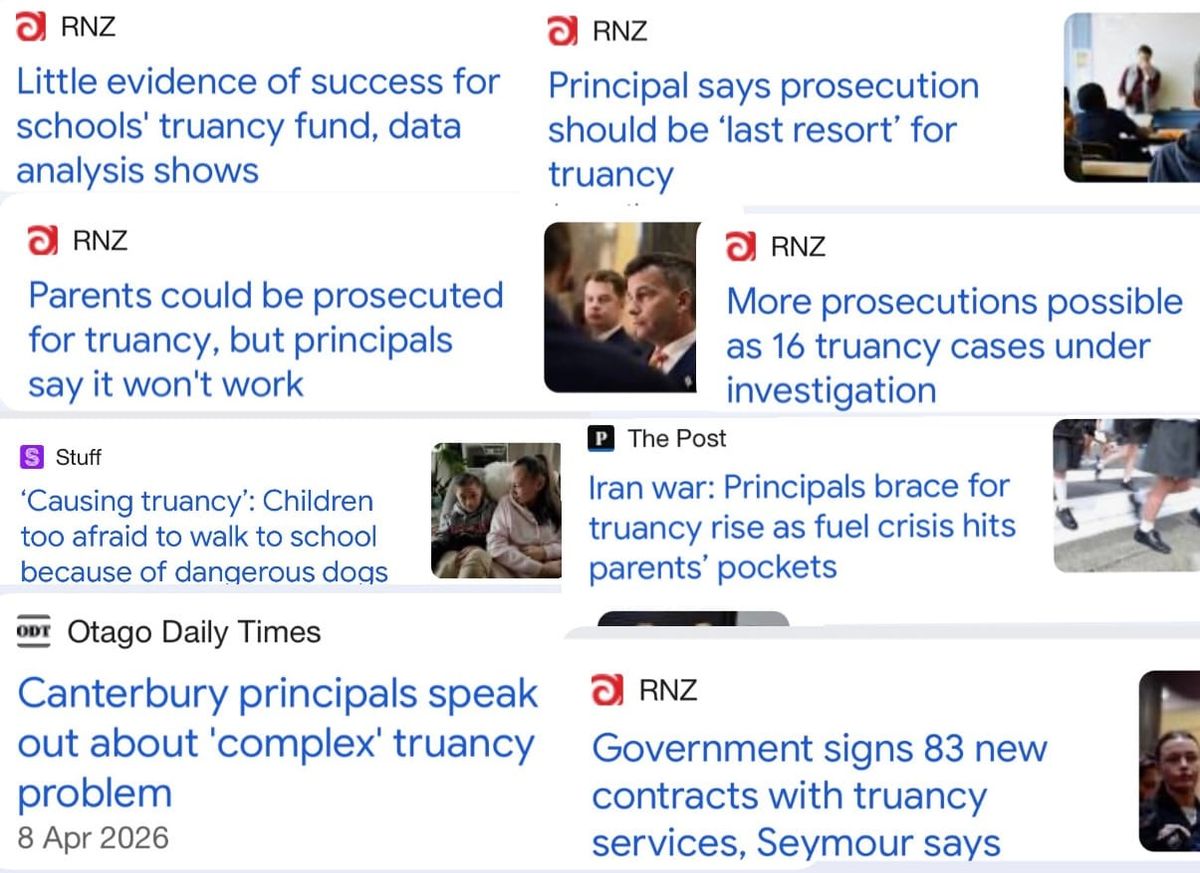
Katie's story is just one of the many experiences I've heard from parents in the last few months as a result of David Seymour's crackdown on so-called truancy.
Every parent I spoke to was terrified of using their name in case their relationship with their child's school and the Ministry further deteriorated. This is devastating considering that schools were once part of a parent's village.
And indeed, many schools still are. Principals and teachers have contacted me in confidence, saying they're protecting their families from what some call "David Seymour's Ministry". There are loopholes, covers, and alibis being used to keep families safe from rules that are arbitrary, inconsistent, and at odds with actually getting a child to attend school.
One principal told me, "I will never hand one of our children and their families over to be fined and prosecuted by someone who has no understanding at all of what some of these families are going through".
Another teacher told me that "trust is at an all-time low with parents". He said he worried that families were falling through the cracks because they were becoming afraid of schools, seeing teachers as 'police'.
"And kids are coming to school really sick because they're worried about absences. They're vomiting and then parents are saying 'if we pick him up will it be an absence'?"
Sarah is a registered nurse working in general practice. She's seen the impact of the pressure put on parents over their children being unwell and unable to attend school.
"The increased need for medical certificates because a child is at home sick is ridiculous. I am aware of two practices who won’t do medical certificates for school, with the exception of external exams, and I personally think that’s very reasonable," she said.
"Medical certificates take time away from patients who actually need to be seen - and since we have a shortage of GPs, that ain’t gonna help. Medical certificates for work are sometimes needed, but honestly, the best employers don’t even ask".
It looks like it's a myth that 'justified' absences, like those where a medical certificate is provided, do not lead to fines. Almost all of the parents and teachers who spoke to me said that justified and approved absences are still counted against children.
The letter sent to parents includes the following:
In line with government policy focusing on improved attendance, you are receiving this email because [student] has been absent for more than [x] half days this term, which includes justified, medical and Principal approved absences.
[I have edited the letter only to remove the child's name and number of absences for privacy. I saw the same wording on the letter sent to many parents and teachers, confirming that this is the letter families get].
Parents told me they've been either sent fines or threatened with prosecution for the following:
- Having a child out of school for two weeks when the child's parent suddenly died.
- A child with leukaemia being told they needed to be taken off the roll even though they were visiting their school - the only community they have.
- A child pressured to attend school the day after emergency surgery.
- Having a child visit a dying grandparent overseas and staying for their funeral, which took three weeks out of their attendance for the year.
- A child being forced to attend school after a sexual assault.
- A child whose parent had moved into Women's Refuge was told they must attend school or their parent would be prosecuted.
- A disabled child who had to regularly have physiotherapy was told school was 'more important'.
Rena says her five-year-old and her whānau suffered greatly due to the system’s treatment of families seeking support.
After repeated bullying and safety concerns at school, she kept her child home because she did not believe it was safe for him to attend. Despite repeated requests for support and a safety plan, a truancy check was later initiated.
The experience was so traumatising for the whānau that they eventually relocated to Australia.
A parent who contacted me, Jane, was sent the letter while her child was in hospital with a serious life-threatening condition.
"Even with a medical reason, my kid is basically in trouble. And it feels like I am too," she said.
At a time when all of her focus was on her child and the ordeal they were going through, Jane had to deal with requirements to meet and further explain her child's illness.
"She's still an inpatient and may be for some time. I told her school that she was in the hospital. What happens if I don't go to the meeting, I wonder?" she asked. "Do I get a fine?"
"I know it's important my kid learns algebra and how to use a protractor. But I resent the implication that she's in trouble and has basically been called to the principal's office. A meeting about her absences would be super stressful for her and freak her out at a time when her health is at risk. She already worries that she's not as good as her peers."
"Don't they realise my kid is the most important thing in the world to me? And I'm doing all that I can to help her get along as a teenager?"
The Ministry of Education set up a attendance prosecution unit under the orders of David Seymour last year. They told RNZ that parents could be fined up to $300 for a "first offence" and $3000 for a second or subsequent offence.
They maintained the ministry did not prosecute parents of students who were genuinely engaging with the school, or those who were absent because of chronic illness or health conditions associated with a disability.
The stories I've seen from many parents suggest that this is untrue.
Have you or your child been impacted by the Ministry of Education's hardline absences policy? If you need to contact me in confidence, you can reach me at emilywritesnz@gmail.com.
If you can speak publicly on this or have other thoughts, I'd love to hear what you think in the comments.