
The Brighter Future: The Electric Election
Better things are possible



This year we have been sharing posts imagining a brighter future for our country. A week out from this very crucial election I'm proud to share this Brighter Future by Jenny Sahng, a data scientist and project manager at climate/energy charity Rewiring Aotearoa.
Jenny imagines a world where all political parties come together to commit to climate action. She writes about how every party can live the values they claim and take action for our planet and its people.
Please vote so a brighter future might be our reality. Find your local voting location here.
Arohanui Emily. x
The Electric Election
In 2040, New Zealand became the world's most electric country. Almost all the energy we needed to run our homes, farms and businesses came from local electrons, not imported fossil fuels. And it all started in 2026: the year the fuel crisis hit, and the year every political party in New Zealand realised they had to start taking climate change and the energy transition seriously.
It was a long time ago now, but in 2026 Covid-19 wasn't that far in the rear-view mirror (yes, the pandemic the Old Millennials won't shut up about). It was a big shock, and then the fuel crisis came only a few years later. Back then, the world was tangled up in long, fragile supply chains of "fossil fuels" – ancient oil from deep underground. Big corporations would do anything to dig it up and ship barrels of the sludgy, flammable stuff around the world on giant fossil-powered ships, selling this scarce, inefficient energy for enormous profits. Looking back, it all feels a bit Mordor, but back then we thought it was normal!
Here in Aotearoa, we had a pretty renewable grid, but around 70% of our energy still came from fossil fuels. Any time that flow stopped or slowed, so did the machines. You can't imagine it now, but almost everything depended on them – the tractors farmers used to grow our food, the diesel trucks getting food to our supermarkets, the cars many people still had to drive to get to work.
It was also an election year in New Zealand.
In 2026, politics felt more polarised and short-term-focused than ever, both at home and abroad, veering away from the common ground most New Zealanders wanted: respite from the ever-increasing cost of living and worsening weather events.
What we didn't understand then was that Aotearoa was in a lucky position. Because we're so isolated at the end of these fossil fuel supply chains, we'd always paid more for fossil fuels than almost anyone. That made switching to electric alternatives a win-win, for the economy and for the climate. Already, back in 2026, it was cheaper to run a home on electric appliances and heat pumps than on gas and petrol. The maths already worked: fixing climate change was actually cheaper than not fixing it. The fuel crisis made that impossible to ignore.
Meanwhile, we'd watched Australia's decade-long solar revolution result in three hours of free midday power for millions of households, renters included. Ethiopia and Norway were electrifying their car fleets faster than anyone had thought possible, while New Zealand was world-infamous for backsliding on EV policy. China was exporting all manner of electric machinery at competitive prices. The technology wasn't luxury or experimental: it was mostly just heat pumps, induction cooktops, solar panels, EVs, e-bikes, and electric lawnmowers, sitting on the shelves at Mitre 10 or on Trade Me. Of the ten million fossil fuel machines running in New Zealand, 8.4 million already had mainstream electric alternatives. We could have warm homes, affordable transport, clean air, and resilient, thriving industries, all while decoupling ourselves from the Strait of Hormuz and every other fossil fuel fiasco.
The public did the maths. We wanted that affordable, resilient, electric future, and we got very, very loud. This part I remember clearly: every interview, every phone call, every community campaign meeting, people wouldn’t stop asking politicians about how we could get New Zealand off imported fossil fuels and running on locally-made electrons. Not only for our homes, but our industries too: polling that year found that taxpayers vastly preferred spending $1b on renewables to help decarbonise our big gas users and regional economies. Parties knew that they had to do something about the fuel crisis, the energy prices, and their obvious solution: electrification.
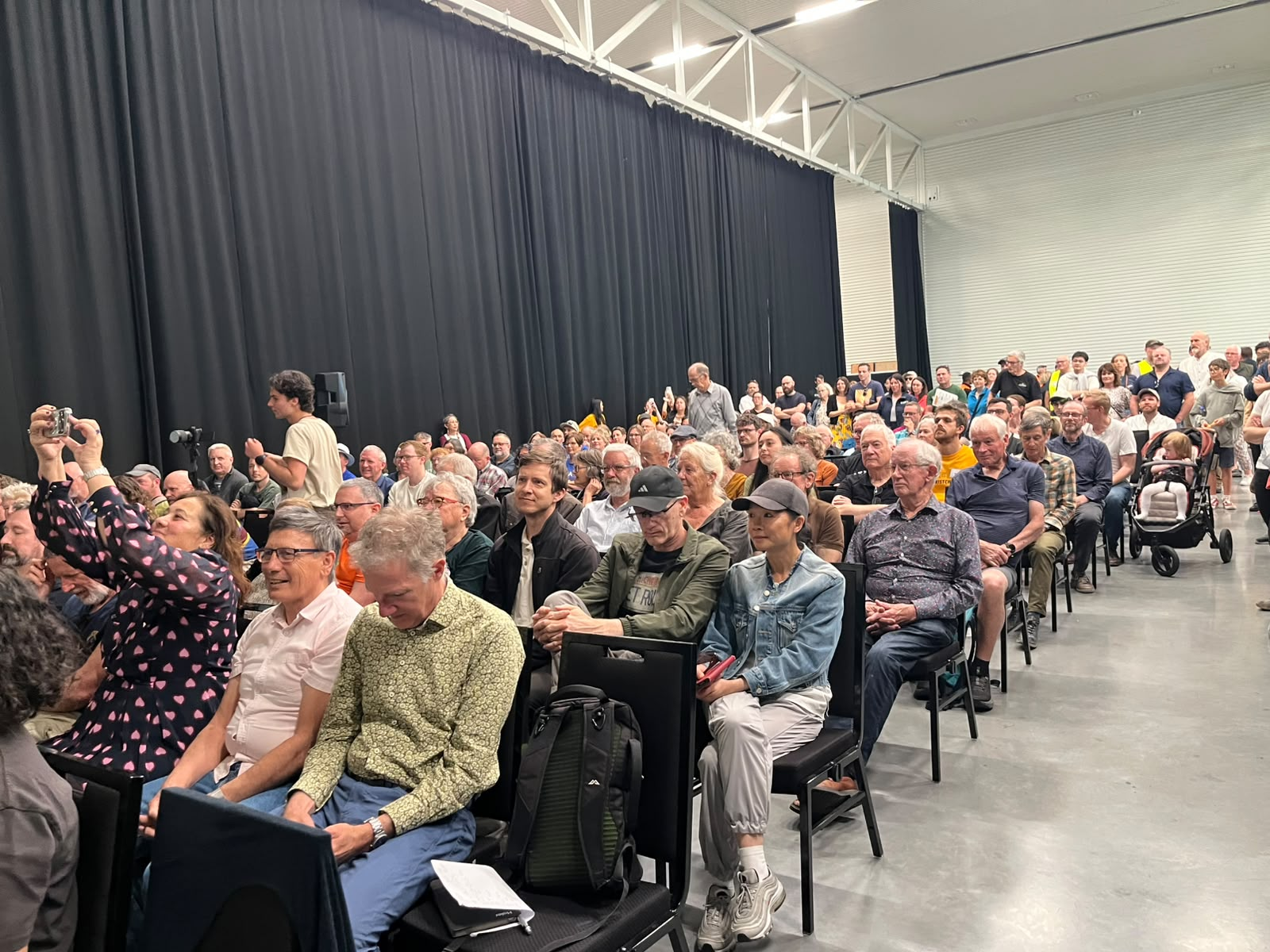
Slowly, and then all at once, it changed. By election day in November 2026, every single party had policies supporting electrification.
- National supported legislation to enable the Ratepayers Assistance Scheme (RAS). I know it’s hard to imagine a time before it, kind of like KiwiSaver, ACC, or interest-free student loans, but this election was when it came to be! Before that, if you wanted solar panels or a hot water heat pump but couldn’t afford the upfront cost, you went to a bank and hoped you qualified for a green loan. Retired? Single income? Business? Farmer? Good luck. But the RAS changed all that. For the first time, any rateable property, commercial or residential, could take out low-cost loans for electrification upgrades like solar, heat pumps, hot water heat pumps, and batteries. People didn’t have to rely on private finance or banks anymore, even if they were retired or didn’t have a stable income, because it was secured against the property. The best bit was that the loan term was long enough that repayments and interests were less than the bill savings, so people were better off from day one. Suddenly, the upfront cost barrier was gone. Labour, Greens, Opportunity, and Te Pāti Māori also supported this in their election policies, so we knew even before the election results that we were finally going to get this real change.
- ACT went after red tape, promising to bring our 20-year-old solar regulations in line with modern norms seen in Australia, who had 10x more solar adoption than us (back then at least; they had a massive head start, but we beat them to 80% adoption in the end). They had also started the work to unlock balcony solar, also supported by Labour and the Greens, which brought immediate power bill relief for renters and those in high density housing with tricky body corp rules. They were interested in more peer-to-peer electricity trading, the Free Trade of Energy, where a farmer can sell excess solar to the milk processing plant down the road, and a marae or church can give away power to its community. The Greens agreed with them on that one!
- NZ First wanted regional industries to thrive on cheap energy that didn’t rely on foreign imports with fragile supply chains, framing energy independence as national security. No more of our economy being held hostage to wars in countries far away.
- Opportunity ran on a platform of abundance: more renewable generation, a modernised electricity market that worked for consumers, and support for the RAS. They also proposed ringfencing gentailer profits to invest in renewables, and were one of the few parties with an EV policy - a fringe benefit tax exemption. This was crucial back in 2026 when pump prices were a big chunk of expenses, and businesses were still buying 10,000s of new petrol cars every year!
- Labour, alongside much of the above, campaigned on a SolarSaver subsidy so things were accessible for low- and middle-income homes, and a $30 million fund for community batteries. We also didn’t have enough electricians and solar installers back in 2026 - demand was skyrocketing and qualified workers were hard to find. So Labour promised to grow the solar workforce, including extending their Apprenticeship Boost for two years. Crucially, they committed to cancelling the LNG import terminal; the Strait of Hormuz conflict had shown once and for all that importing gas would be terrible for our industries, making the proposal totally uneconomic. Most of the National MPs were also glad to see the back of that unpopular policy.
- The Greens already had a comprehensive, well-costed energy policy around affordable electrification and electricity market reform. But they went even further, offering to subsidise the interest on the RAS, expanding Warmer Kiwi Homes including helping households get off gas, investing $200m for community-owned renewable energy like solar on schools, marae, and libraries, and phasing out fossil fuel vehicle imports so households aren’t locked into decades of expensive, polluting transport.
- Te Pāti Māori campaigned on energy sovereignty and independence, supporting grassroots energy projects that reaped the benefits of renewable generation, improved community resilience, and decoupled the electricity market from profit-generation motives.
There were a few politicians in each party who opposed electrification. Some thought it sounded “woke”, others had outdated information about how affordable these technologies had become, some were worried about the mining impacts. But they couldn’t resist the momentum. The public had decided, and the politicians had to follow, in what the press had dubbed the “Electric Election”.
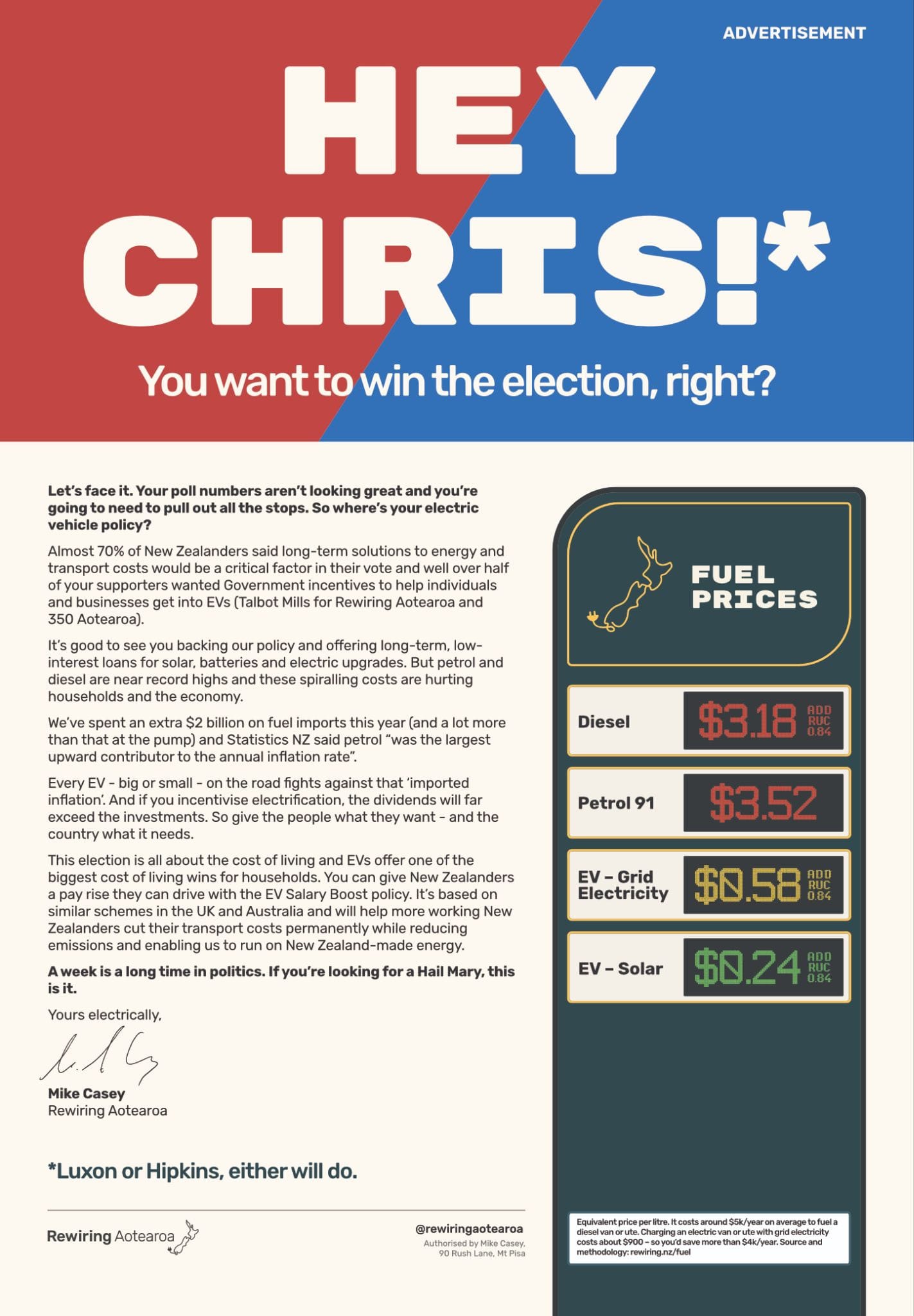
You might wonder why the two major parties were so quiet on EVs during a fuel crisis. Both had been so spooked by the "ute tax" backlash in 2023 that they didn't want to go near EV policy, even though petrol and diesel cars made up such a big chunk of our energy emissions and household bills. But the polls were looking grim, so just a week out from November 7th, both threw a Hail Mary: a last-minute EV Salary Boost policy which would let people who needed immediate fuel cost relief, like nurses and teachers, get into a new EV without a big upfront cost.
After that election, we went hard and fast. First we picked the low-hanging fruit: heat pumps, electric water heaters, induction cooking, EVs, solar panels, and batteries. These required no behaviour change; they were a straight swap to a cleaner, more efficient machine that saved people money. This virtually eliminated all household operating emissions. With the RAS, upfront cost wasn’t an issue anymore for homeowners. And with the farm solar support that came online earlier in 2026, farmers led the charge on “de-woking” solar for the chunks of the country who might have been skeptical of it in the past.
Electrification of the car fleet cut our emissions faster than even the Climate Change Commission’s most ambitious modelled scenarios. Climate change is a cumulative problem; emissions stay in the atmosphere and keep warming it, so fast, early reductions during that critical window mattered a lot. The households that had no realistic alternative to driving back in 2026, but could swap petrol for an EV, helped us avoid a whole lot of warming.
These low-hanging fruit bought us time for the trickier changes we needed to become a more affordable, resilient, and sustainable country.
The rest of the machines were harder. In 2026, 700,000 fossil fuel machines - the big tractors, combine harvesters, airplanes - had no affordable electric option. But having electrified most of the other machines, we'd seen the benefits, and we rolled up our sleeves. That No. 8 wire mentality came back in a big way: the country that gave the world the jet boat and instant coffee now gave it hydrofoiling electric ferries and electrically farmed cherries. Government, iwi, business groups, and activists worked together to change the narrative around climate action. It wasn’t about sacrificing what we loved; it was about turning towards a better life. An induction stovetop meant a non-toxic kitchen and easy cleanup. An EV meant being able to “fill up” for cheap, at any of the millions of “fuel pumps” around the country - a 3-pin plug. An e-bike flattened hills and gave you door-to-door service. Heat pumps meant using a third to a quarter of the energy of any other heating technology. And of course, solar and batteries meant low power bills and resilience in outages. Climate action wasn’t a difficult, expensive thing anymore; it was a no-brainer, it was exciting, something that everyone wanted to get amongst.
In 2026, before the fuel crisis hit in March, New Zealand had been spending $55 million every single day on fossil fuels. Most of that money went straight overseas to fossil fuel corporations. The electrification wave started in the mid 2020s, and by 2040 most of those fossil fuel bills were gone, and we’d saved $95 billion and countless emissions during a critical window in our climate story. Those savings flowed through the country, funding big policy changes and grassroots community efforts alike, supporting the many other much-needed changes to reduce our other impacts on the planet and to share the benefits of new technologies more fairly.
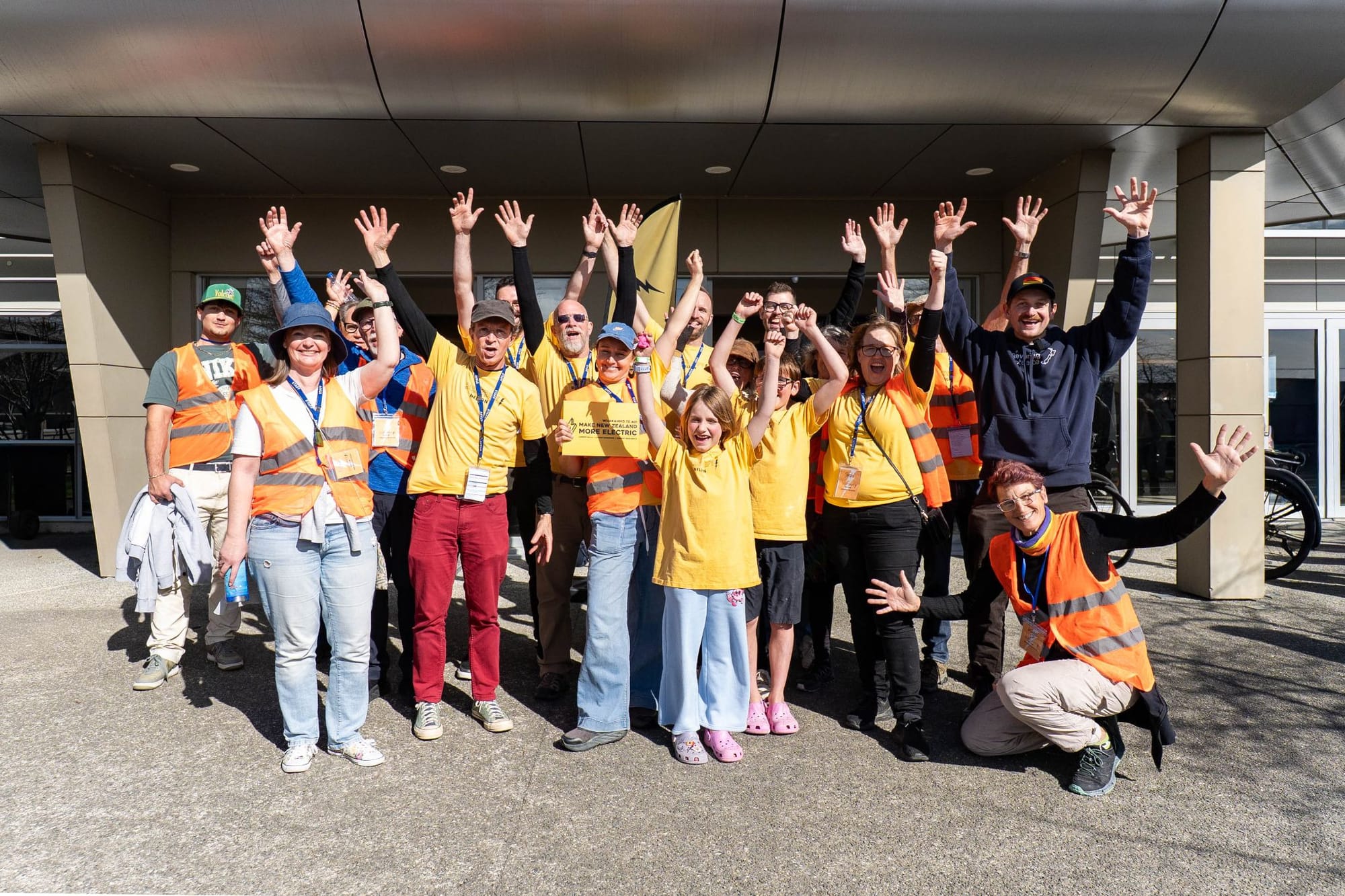
By the 2029 election three years later, New Zealand was making headlines across the world. After a slow start, our isolation and two degrees of connection turned out to be a major advantage. Electrification was a hot topic (literally; it was getting hotter, and people were grateful their heat pumps could also do cooling!). Neighbours were comparing solar apps. Parents were dropping off kids on e-bikes and EVs. Aunties and uncles were comparing their latest electric garden shed tools. Grandparents were marvelling at the serenity of a neighbourhood with no belching exhaust pipes. Electric community groups popped up in every neighbourhood, locals helping locals with recommendations, troubleshooting, and honest reviews of their electrification journeys. Together, they talked to their councils and MPs, ran expos, and gave out free food at local markets with BBQs powered by their EV batteries.
Soon, Aotearoa became a lighthouse for other countries that were also desperate to rid themselves of their fossil fuel ball-and-supply-chain. Perhaps it shouldn't be too surprising. New Zealand was the second country to install electric streetlamps, the first in the southern hemisphere to install transmission lines. Now we had the first fully electric neighbourhoods, towns, farms, and - later - cities. People came from all over the world to learn how we'd demanded better from our politics and politicians. Tourists came to admire a country living in the future, with quiet streets, clean air, and fascinating electric technology from our electric jet boats to electric passenger trains. And our young people would go on their OE, and then come back, knowing that home meant not only cleaned-up beaches, rivers, and mountains, but also an affordable, resilient, future-proof foundation on which to build the next chapter of their lives.
It's easy, in 2040, to think this was inevitable. Of course electrons from your roof are cheaper than fossils from halfway across the world. Of course people would choose cheaper, cleaner machines when the barriers are removed. But I don't think it was inevitable at all. Look, even now, some countries are still untangling themselves from those fossil fuel supply chains, still waking up every morning not knowing what the week will cost. I think the change requires something specific: a moment when the pain was real enough, the alternatives were ready enough, and the people were motivated enough to make their voices heard. Those conditions arrived all at once back in 2026; we took that opportunity and got out. We got Aotearoa running on New Zealand-made electricity, and all else flowed from there.
Jenny Sahng is a data scientist and project manager at climate/energy charity Rewiring Aotearoa, which exists to create the most affordable, renewable energy system for Aotearoa. Before Rewiring, she worked in tech for 8 years, and volunteered in climate activism including as co-founder of Climate Club Aotearoa.