
Where is the school?

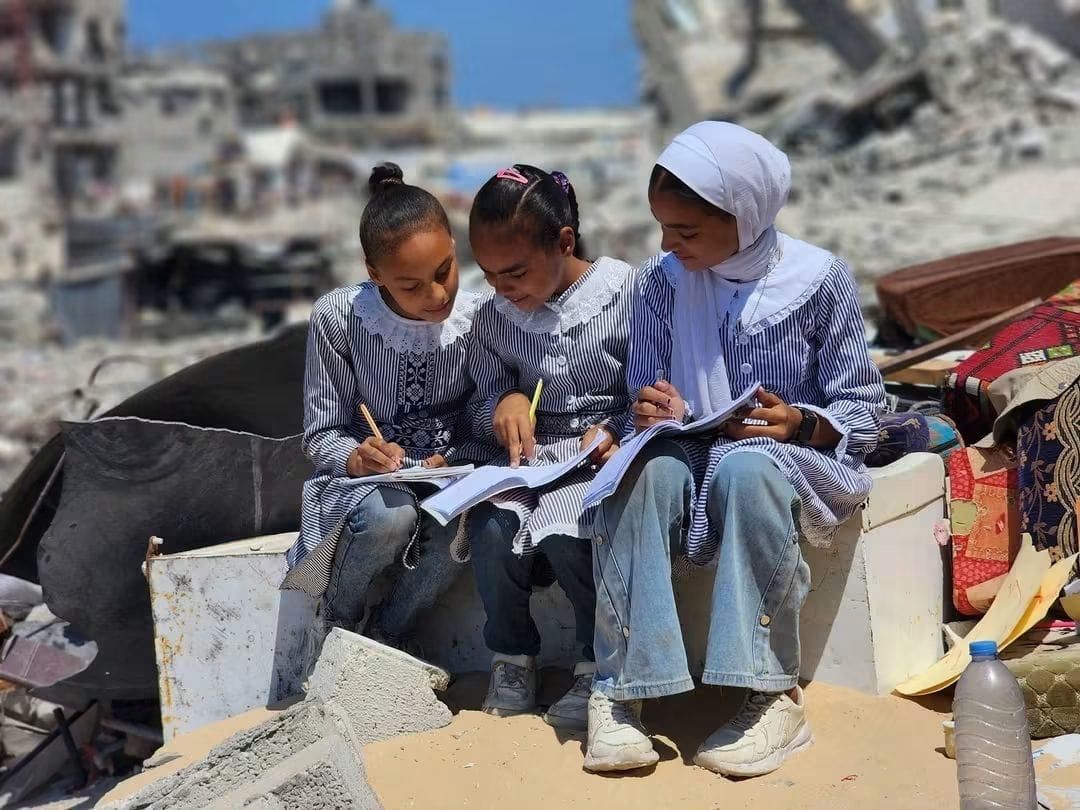
After nearly three years of genocide, children in Gaza have finally begun going back to school.
Skip to the comments if you read this already in your email.
Our correspondent in Gaza, Dr Jehad Malaka shares what it’s like for these children, including his own.
For three years, Gaza’s children have been denied face-to-face education. Now they are returning. But they are not returning to the schools they remember - or, for many of them, to schools they ever knew.
On 19 September 2026, the new school year began in Gaza in displacement tents and temporary learning spaces, rather than in functioning school buildings. Many schools have been damaged or destroyed, while others remain unsuitable for use.
For my daughter, Eileen, the first day of school was not a moment of excitement. It was a moment of confusion and sadness.
I asked her why she was unhappy.
She looked at me and asked:
“Where is the school? Do you call a tent made of cloth a school? Where are the chairs? Where are the desks? Where is the blackboard?”
I had no answer.
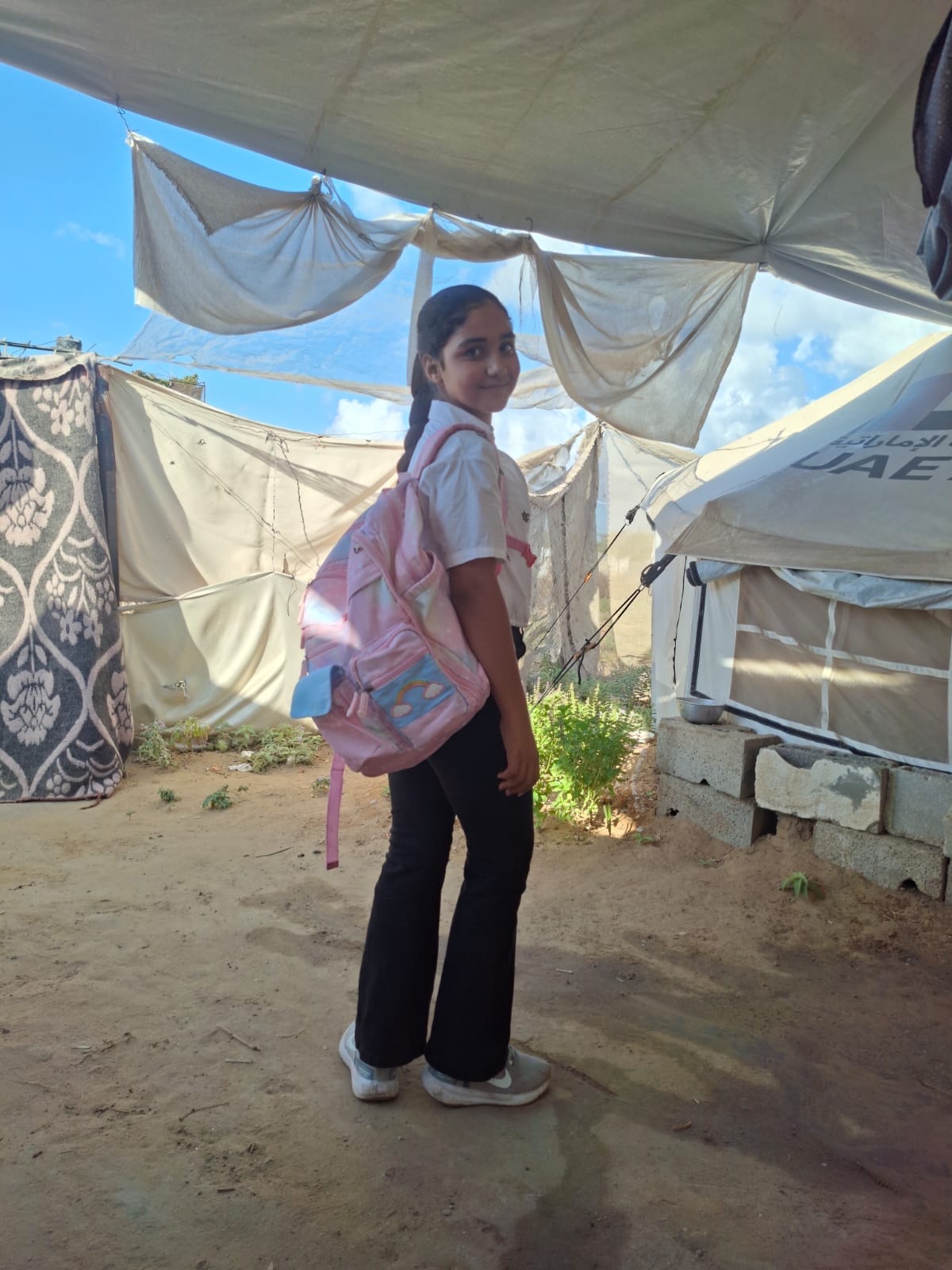
Her questions were those of a child. But they expressed something much larger: the collapse of the ordinary world that children everywhere take for granted.
When a tent becomes a school
In the Deir al-Balah displacement camp, I accompanied Eileen to an UNRWA-supported school.
It was, in reality, a collection of tents.
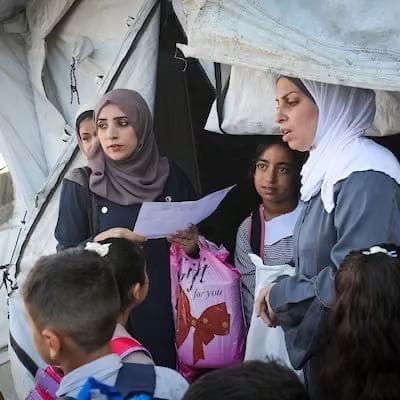
Children gathered for the morning assembly. Some stood in line while others sat on the ground because there were not enough desks and chairs.
I spoke with the school principal, Ms Nabila. Her words reflected the enormous gap between the decision to reopen schools and the reality on the ground.
“The return to education is taking place under conditions that lack even the most basic educational necessities. After the war, we are missing many of the things that should be available to us. We urgently need desks, stationery and textbooks so that we can begin to make up for the learning students have lost because of the war and the interruption of their education.”
Her words point to a truth that is easy to overlook: reopening a school does not necessarily mean restoring education.
A tent can provide shelter from the sun and rain. It can provide a teacher with a place to stand and children with a place to sit.
But a school is more than a roof, a teacher and a textbook.
It is a place where children feel safe. It is where they make friends, play, discover their abilities, participate in sports and cultural activities, visit a library, conduct experiments and learn how to live alongside others.
It is one of the first places where a child encounters something resembling normal life.
For Gaza’s children, that normality has been shattered.
“They know nothing but war”
I also spoke with our neighbour, Umm Ali.
When the war began, her child was three years old. He is now six and has entered first grade.
She told me:
“Our children woke up before dawn. They do not know what school means. They do not know what a morning assembly is, and they do not know what normal life looks like. They know nothing but bombardment and war.”
She tried to keep him learning during the years when schools were closed.
“We used to send him to a private tutor so he could keep up, but nothing can replace education at school.”
Then she described the reality facing families who are trying to send their children back to class while struggling simply to survive:
“Things are extremely difficult now. School bags are expensive. Our homes have been destroyed and we are living in tents. The school itself has also become tents rather than a normal school.”
Her words capture the double burden facing Gaza’s families: they are being asked to rebuild their children’s education while their own lives remain in ruins.
Three years is a lifetime for a child
For an adult, three years may pass quickly.
For a child, three years can be an entire stage of development.
A child who should have been learning to read, write, calculate, communicate and build relationships has instead spent those years moving from one displacement to another, living with fear and uncertainty and trying to understand a world defined by bombardment and loss.
The damage cannot be measured simply by the number of lessons missed.
What has been lost includes knowledge and skills, but also routines, friendships, confidence, social development, sports, creativity and the experience of simply being a child.
The educational crisis in Gaza is therefore also a childhood crisis.
And the longer the disruption continues, the harder the road back becomes.
Three hours a day. Three days a week.
Even now, the return to school does not mean a return to a normal school day.
Because of the shortage of temporary classrooms and the severe lack of teachers, students in many cases will receive only around three hours of instruction a day, three days a week.
That means children who have already lost nearly three years of education are returning to a system that itself cannot yet provide the full time needed for learning.
Teachers will have to compress lessons, move more quickly through the curriculum and make difficult choices about what can and cannot be taught.
Students will have less time for revision, practice and reinforcement. Parts of the curriculum may inevitably be left uncovered.
And the activities that make school more than academic instruction — sport, art, culture and social activities — will also be severely restricted, if they take place at all.
The danger is clear.
Children are not simply returning late to school. They are returning to an education that is limited in time, space, content and opportunity.
For a generation already carrying an enormous learning gap, this could make catching up even more difficult.
The challenge is no longer simply getting children back into classrooms.
It is making sure that being back in school actually gives them a meaningful education.
Teachers cannot rebuild Gaza alone
The teachers standing in these tents are facing the same war as the children they teach.
Many have lost homes, relatives, possessions and livelihoods. Many are displaced themselves. Yet they return to the classroom because they understand what is at stake.
They are not simply teaching mathematics, reading or science.
They are helping children recover a sense of routine.
They are reminding them that there is a world beyond the next air raid, the next displacement and the next night spent in a tent.
In that sense, every teacher who enters a temporary classroom is doing more than teaching.
They are keeping open a door to the future.
But teachers cannot do this alone.
They need books, desks, stationery, adequate learning spaces, trained staff, psychosocial support and, above all, safe environments in which children can learn.
Rebuilding Gaza means rebuilding its children
The reconstruction of Gaza cannot be measured only by the number of homes, roads and buildings that are eventually rebuilt.
There is another reconstruction that is less visible but no less important: rebuilding the lives, confidence and futures of the children who have survived the war.
Education must be at the heart of that effort.
Every classroom restored is more than a repaired building. It is a place where a child can begin to imagine a future again.
Every book placed in a child's hands is more than a textbook. It is a bridge back to a life that was interrupted.
And every teacher who returns to the classroom is helping to restore something that war cannot be allowed to destroy permanently: the belief that children have a future worth preparing for.
I keep thinking about Eileen’s question:
“Do you call a tent made of cloth a school?”
Perhaps a tent can become a temporary place of learning.
But it cannot be allowed to become the definition of education for an entire generation.
The children of Gaza deserve more than survival.
They deserve real schools. They deserve desks and books, libraries and playgrounds, laboratories and sports fields. They deserve art, music, friendship, safety and the ordinary routines of childhood.
Most of all, they deserve the chance to learn without having to first survive a war.
Gaza does not need only its schools rebuilt. It needs its children’s futures rebuilt — so that an entire generation is not left behind beneath the rubble.
Thank you again for your generous support of Emily Writes Weekly. None of what we do would be possible without paid subscribers. If you cannot afford to pay a paid subscription right now, please share this newsletter on social media or forward it to a friend. We are all in this together, and every act of kindness helps build a better world.