What the hell is going on between the Coalition Government and the Public Service Commission?
It's not normal for public servants and the Government to collude against unions like this.

Late in 2025, the Public Service Commission did something that it is very much not supposed to do.
It took the Government's side - in a pay negotiation between it and the unions representing doctors, nurses, and teachers.
Why does this matter?
The New Zealand public service is required by law to be politically neutral.
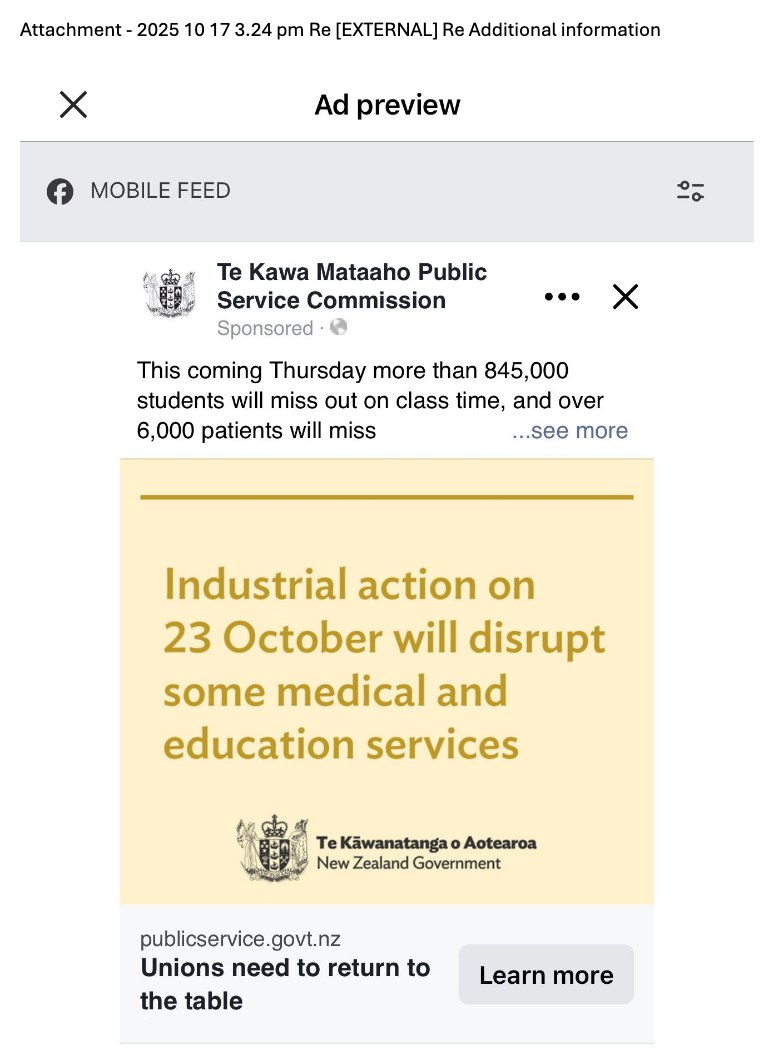
This is why politicians, journalists, commentators and politics-watchers of all kinds were stunned when the Public Service Commission unveiled a paid social media advertising campaign targeting the "Day of Action" strikes involving doctors, nurses, and teachers, who were involved in collective bargaining via their respective unions.
The OIA documents also show that the PSC was prepared to spend a staggering $10,000 on this unprecedented attack.
This is not normal.
It is normal for public services to let ministers know what they are working on. The Public Service and the Government operate a "No Suprises" policy. Introduced during the Lange Government in the 1980s, "No Surprises" means "As a general rule, [officials] should inform ministers promptly of matters of significance within their portfolio responsibilities, particularly where these matters may be controversial or may become the subject of public debate."
Paraphrased, No Suprises is supposed to be a heads-up. "Hey, just so you know, we're doing [a thing]. FYI."
But the Public Service Commmission's actions go far, far beyond "No Surprises."
The Public Service Commission claims that there was "no ministerial directive" for their social media campaign, but the emails released under the OIA appear to show what can only be described as ministerial direction.
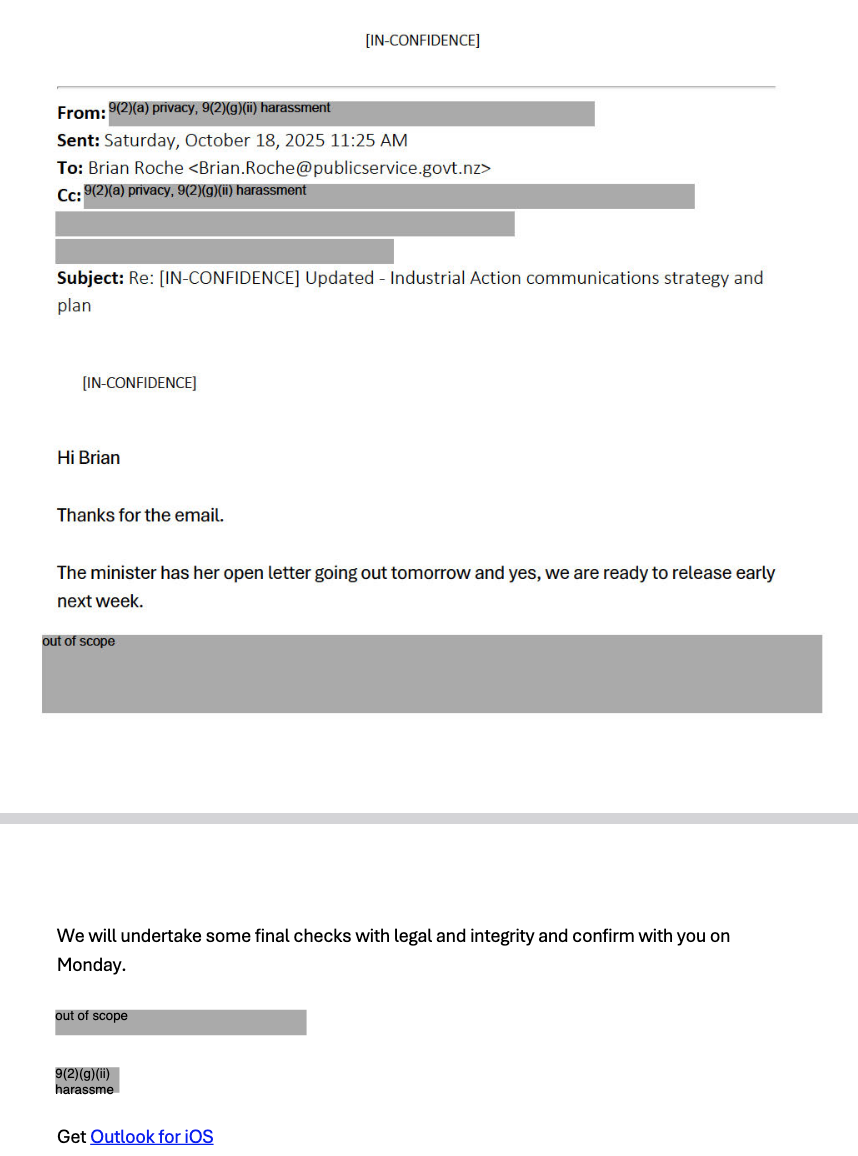
Emails released to the New Zealand teachers' union, NZEI, under the Official Information Act show close coordination - comprising multiple emails, back-and-forth coordination, including corrections and suggestions – between staff at the Public Service Commission and the offices of both the Prime Minister and the Minister for the Public Service, Judith Collins.
The emails also show the PSC's social media campaign was timed to coincide with Minister Collins' "open letter" to the New Zealand public attacking the strike action - another practically unprecedented action.
NZEI, the New Zealand teacher's union, is fuming.
In a December press release, the union says the email trails show a collaboration that extends well beyond "the 'no surprises' convention that government agencies uphold for ministerial offices."
the OIA response includes “internal messages: seeking edits to tile following factual clarification sought from Minister’s office” (p.41). Email trails and text messages record how a live (i.e. published) Facebook advert had to be revised twice following feedback from the office of Minister Collins (p.82-83, 87-88). All these point to direct Ministerial involvement in PSC communications, down to operational, day-to-day decisions relating to this social media campaign.
The OIA response also records that Prime Minister Christopher Luxon was present at a meeting where the PSC’s communications strategy for the 23 October ‘Day of Action’ and the use of social media for this campaign were discussed.
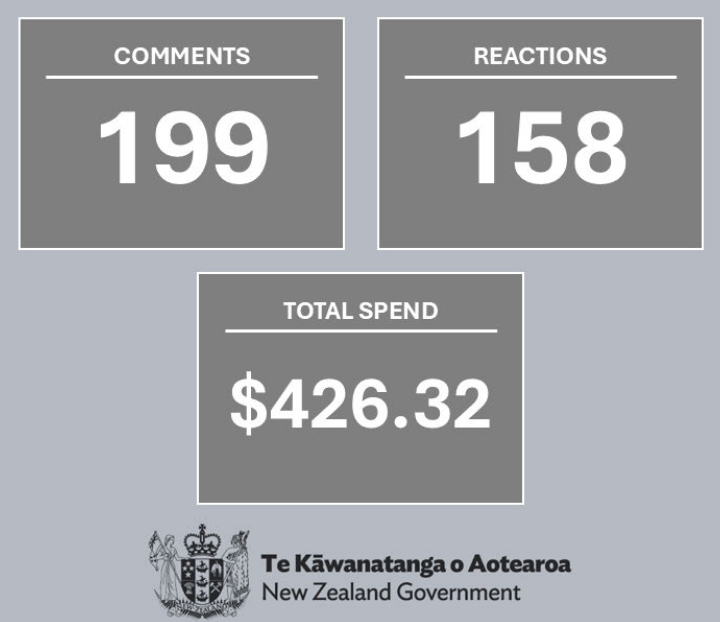
Despite the $10,000 budget sought by the PSC, the final charge for the social media campaign was $426.32. According to Meta reporting, the entire campaign garnered "199 comments" and "158 reactions".
The cost for what must be many, many hours of work across professionals in the Public Service Commission across their Legal, Integrity, Workforce and Communication teams, Minister Collins' office, and the office of the Prime Minister was not revealed in the OIA response.
For these "158 reactions," the Public Service Commission is now under investigation by the Office of the Auditor-General, which has commissioned an external party to carry out a review of the PSC's decision-making.
Was it worth it?
The Bad Newsletter says:
The Public Service Commission's claim of independence in this campaign is farcical; the campaign was clearly being run for the benefit of Government and was even being directed by Ministerial offices - for which Ministers bear responsibility.
It was a smear campaign against valued professionals - doctors, nurses, and teachers - who took strike action over issues that go far beyond pay.
This smear campaign was coordinated in lockstep with attacks from Judith Collins, whose "open letter" claimed that the unions "just don't like our government," and Prime Minister Christopher Luxon, who said "they want to go on strike."
It must be asked whether the Public Service Commission went ahead with this ill-advised action because this government poses a clear danger to public servants and that PSC leadership feel like they must stay on-side: in May of 2024, following Coalition Government policy and budgets, the PSC looked to cut nearly 20 percent of its workforce.
We say: this coordinated campaign with the ostensibly-independent Public Service Commission is yet more evidence that this Government hates unions, purely because unions allow people who would have a weak bargaining position as individuals to have a strong position as a collective.
We take this opportunity to remind readers that no matter what you do for a job, you should belong to a union, that unions are one of an individual's best protections against rapacious bosses and corrupt politicians, and here is a resource to help you join a union today.